

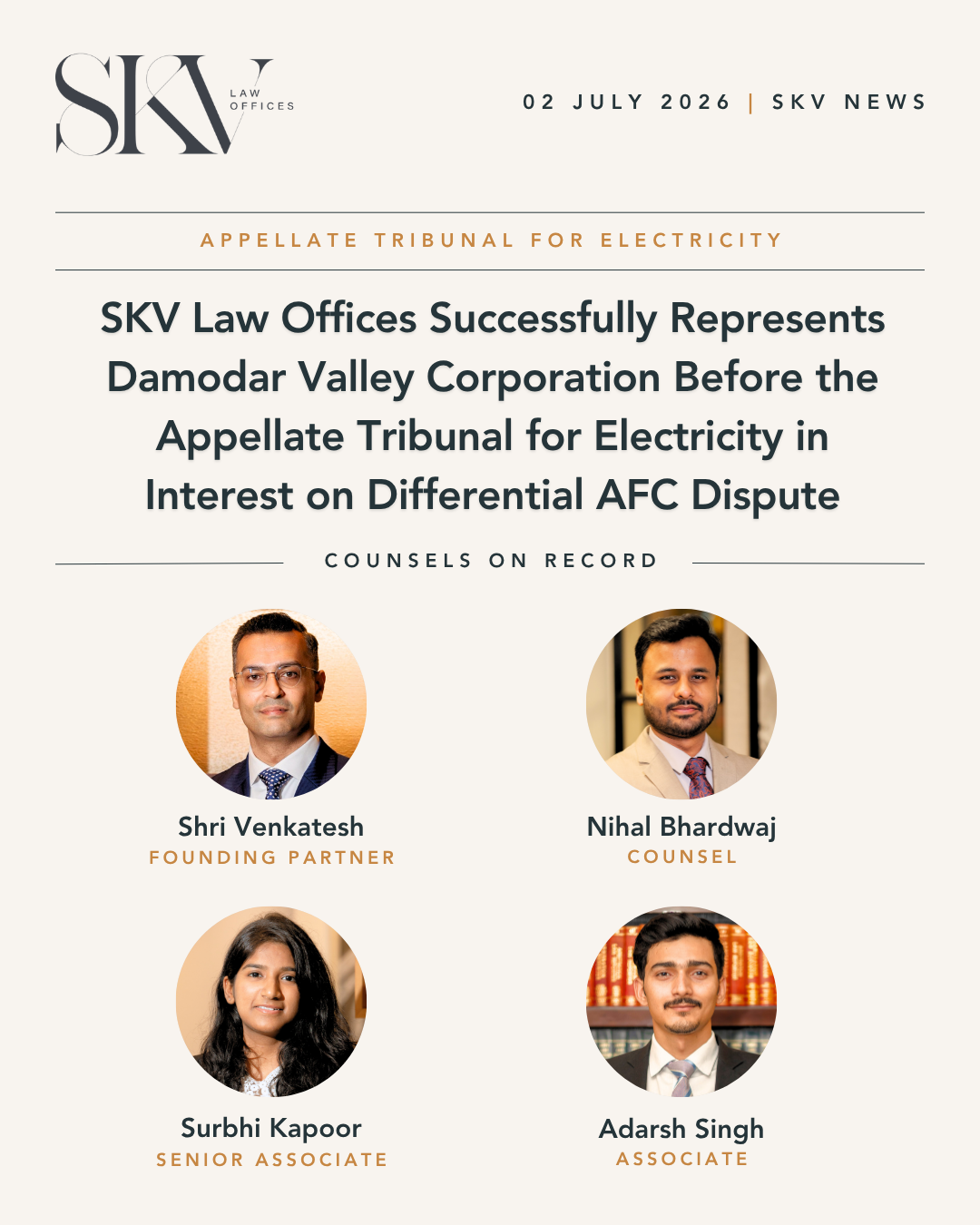
SKV Law Offices Successfully Represents Damodar Valley Corporation Before the Appellate Tribunal for Electricity in Interest on Differential AFC Dispute
03.07.2026
SKV Law Offices successfully represented Damodar Valley Corporation (DVC) before the Hon’ble Appellate Tribunal for Electricity (APTEL) in Appeal No. 15 of 2026 filed by the Damodar Valley Power Consumers’ Association (DVPCA) and 31 of its member industrial HT consumers, challenging the Annual Performance Review (APR) Order dated 31.03.2025 passed by the West Bengal Electricity Regulatory Commission (WBERC) in Case No. APR-125/24-25 for FY 2021-22, insofar as it related to the computation of interest on differential Annual Fixed Charges (AFC).
The dispute arose from the methodology adopted by WBERC, at DVC’s instance, for computing interest on differential AFC for FY 2014-17, whereby the AFC considered in the Tariff Order is normalised by the ratio of actual energy sales to projected energy sales before being compared with the trued-up AFC. The Appellants contended that the APR Order dated 08.06.2023 had attained finality and could not be reopened, that the so-called “empirical formula” was introduced belatedly through review petitions, that it artificially reduced the principal differential AFC (claimed at Rs. 961 Crore, with interest of approximately Rs. 2,203 Crore) on which interest was payable to consumers, and that its application converted an earlier consumer benefit of Rs. 51.83 Crore into a liability of Rs. 200.35 Crore.
SKV Law Offices defended the methodology on behalf of DVC and argued that:
- The APR Order dated 08.06.2023 had expressly kept the computation open pending issuance of CERC true-up orders for several generating stations of DVC, and the determination of interest on differential AFC had therefore never attained finality;
- A direct comparison of AFC computed on projected sales assumptions with AFC computed on actual sales is mathematically incorrect, as the two figures rest on different sales denominators; the projected AFC must first be normalised to actual sales to ensure a like-to-like comparison, failing which a notional surplus is artificially created on which no interest can be claimed;
- The exercise undertaken in the Impugned Order was a rectification of an error apparent on the face of the record, squarely covered by Regulation 2.5.3(v) of the WBERC Tariff Regulations, 2011, which expressly provides that such rectification shall not be treated as a review;
- The Appellants could not approbate and reprobate, having consciously accepted the very same methodology for FY 2017-18 and FY 2018-19, where its application substantially reduced DVC’s interest liability, while selectively challenging it for the years in which it did not operate in their favour.
The matter involved important questions concerning the finality of tariff determinations, the distinction between rectification and review in tariff proceedings, the treatment of sale volume of electricity as an uncontrollable factor, and the principles governing computation of interest on differential AFC under the regulatory framework. By its judgment dated 02.07.2026, APTEL dismissed the appeal and affirmed the Impugned Order insofar as it relates to computation of interest on differential AFC.
The ruling is significant for the power sector as it affirms that recovery of fixed costs is intrinsically linked to actual energy sales, mandates a like-to-like comparison of AFC resting on a common sales denominator, and protects utilities from claims computed on notional differentials arising from amounts never actually collected from consumers.
Team
The matter was led by Mr. Shri Venkatesh, Founding Partner, along with Mr. Nihal Bhardwaj, Counsel, Ms. Surbhi Kapoor, Senior Associate, and Mr. Adarsh Singh, Associate, from SKV Law Offices.