

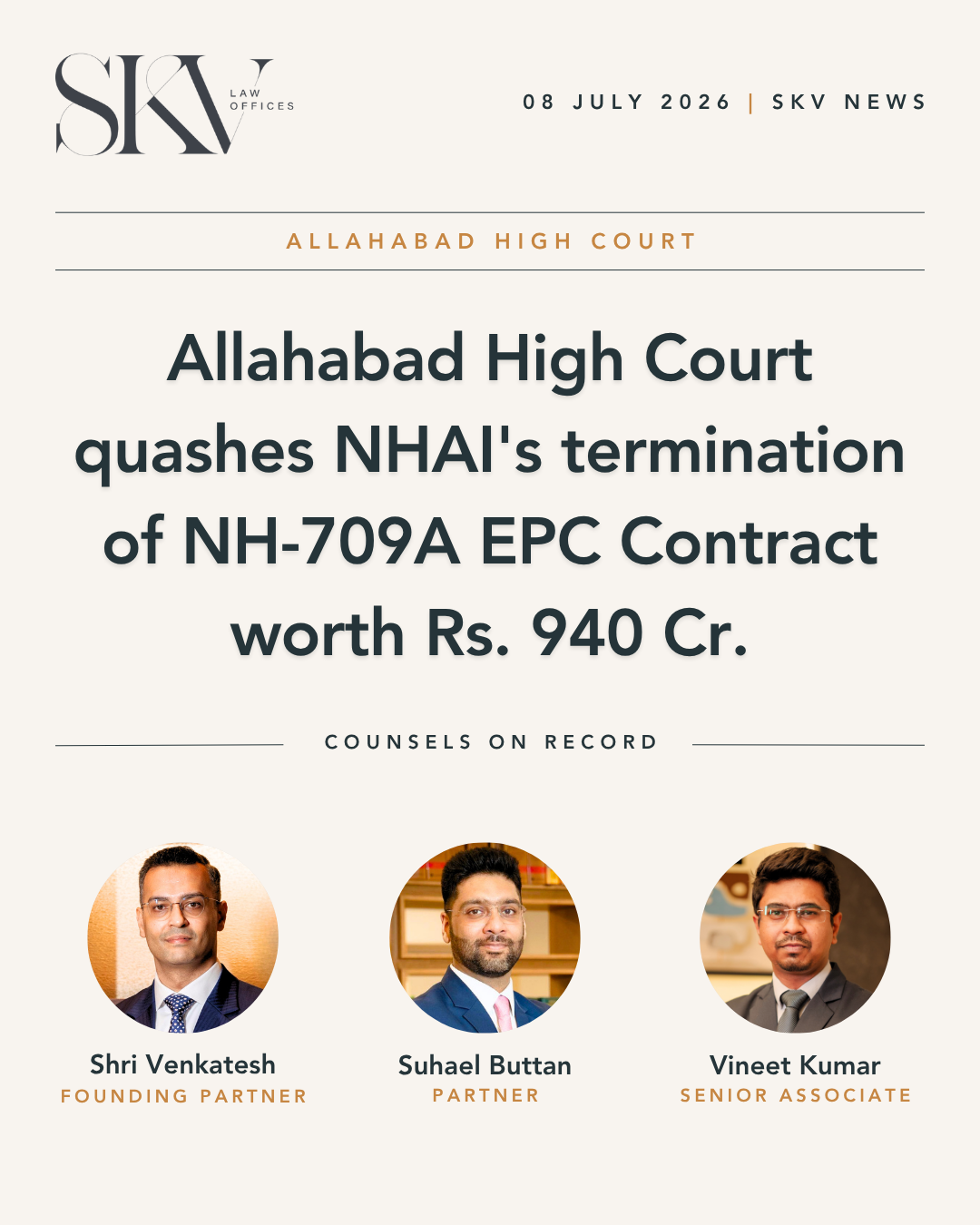
Allahabad High Court quashes NHAI’s termination of NH-709A EPC Contract worth Rs. 940 Cr.
09.07.2026
SKV Law Offices has secured a crucial Judgment in favour of Tata Projects Limited (TPL) in a challenge raised to termination of EPC Agreement by National Highways Authority of India Limited (NHAI) before a Division Bench of the Allahabad High Court (the Court). The EPC Agreement between the parties contained a standard arbitration clause, and NHAI resisted the maintainability of writ petition basis the same. Rejecting the contentions of NHAI, the Court proceeded to set aside the termination as well as the fresh tender issued by NHAI and the forfeiture of bank guarantees.
Background
NHAI awarded the work of widening, strengthening and upgradation of NH-709A from Garhmukteshwar to Meerut to TPL at the project cost of Rs. 940.68 crores under an EPC Agreement in August 2021. The scheduled completion date of the work for the said project was 10 October 2023. One of the most crucial elements for completion of the project was the encumbrance free land, which NHAI was required to provide within the timelines envisaged under EPC Agreement. However, the project was beset by persistent hindrances on the ground, including unresolved land acquisition and compensation disputes, standing religious and private structures, farmer agitations and unshifted utilities, which prevented TPL from accessing contiguous hindrance free stretches of the site and undertake the contractual obligations as mandated under the agreement. Despite the NHAI’s Engineer repeatedly recommending substantial extensions of time, NHAI granted only 42 days and ultimately proceeded to terminate the EPC Agreement on 14.01.2025, followed by forfeiture of bank guarantees and issuance of a fresh tender on 03.02.2025.
The Threshold Objection
Aggrieved by the termination of EPC Agreement, TPL approached the Allahabad High Court (the High Court), principally agitating the underlying failure of NHAI to deliver the possession of unencumbered land with Right of Way as contemplated under the EPC Agreement. Relying on Union of India v. Puna Hinda, NHAI argued that the central question, i.e., whether unencumbered right of way had actually been handed over, is a purely contractual and factual controversy, falling squarely within arbitration clause stipulated under the EPC Agreement. NHAI relied to argue that measurement and possession disputes of this kind require technical adjudication by an arbitrator, not a writ court exercising Article 226 jurisdiction. NHAI also relied on a Handover Memorandum to argue that the fact of handover of requisite land parcels stands admitted by TPL.
Submissions made by SKV
On behalf of TPL, SKV argued that NHAI failed in fulfilling its principle contractual obligation to provide requisite land within the timelines under EPC Agreement, hampering the actual execution of project on ground. Further, NHAI’s Engineer itself had recognised the delay on account of persistent encumbrances and hindrances on the land, for which TPL was not responsible. Handover Memorandum was a misleading paper formality not conforming to the requirements of EPC Agreement as demonstrated by NHAI’s own correspondence admitting that only 29.914 kilometres out of 50.254 kilometres had actually been handed over, and by the Authority’s Engineer’s report dated 10 July 2024 recording continuing hindrances and recommending a further extension of 247 days.
It was contended that the termination order reproduced the show cause notice verbatim without dealing with the petitioner’s detailed reply, evidencing complete non-application of mind, and that NHAI, being State under Article 12, was bound to act fairly under Article 14 even in the contractual field. Relying on the law settled in ABL International Ltd. v. Export Credit Guarantee Corporation of India, MP Power Management Company Ltd. v. Sky Power Southeast Solar India and A.P. Electrical Equipment Corporation v. Tehsildar, SKV argued that even in contractual matters, where the conduct of State is arbitrary and non-transparent the writ petition is maintainable.
Order
The High Court allowed the writ petition and quashed the termination order issued by NHAI together with the consequential forfeiture of bank guarantees and the fresh tender. The Court held that the Handover Memorandum was an eyewash contradicted by NHAI’s own admissions, that the Authority had failed to discharge its obligations under the EPC Agreement, and that the termination was vitiated by arbitrariness and non-application of mind. Importantly, the High Court has held that even if there are disputed questions of facts, the same cannot be made a smokescreen to guillotine a genuine claim raised in the writ petition.
The Court directed the parties to conduct a joint site inspection within one month and to arrive at a rescheduled completion timeline under the EPC Agreement, taking into account the NHAI’s Engineer’s Report, with TPL undertaking to complete the balance works within 14 months.
Significance
The Judgment is a significant reaffirmation that writ jurisdiction remains available against arbitrary termination of a contract by a State instrumentality where the arbitrariness is established from the State’s own admitted documents and conduct, notwithstanding an arbitration clause. It underscores that a document executed in breach of the requirement stipulated under cannot shield the State from the consequences of failing to comply with binding contractual consequences, and it places the burden of fair play squarely on the State in infrastructure contracts funded from the public exchequer. The decision will be a valuable precedent for contractors facing termination where delay is attributable to the employer’s failure to provide hindrance free land.
Team
The matter was led by Shri Venkatesh (Founding Partner) along with Suhael Buttan (Partner) and Vineet Kumar (Senior Associate), who represented Tata Projects Limited before the Hon’ble Allahabad High Court. The team briefed Senior Advocates Shashi Nandan and Amit Saxena, who appeared and argued the matter before the Division Bench.
The Judgment can be accessed here.