

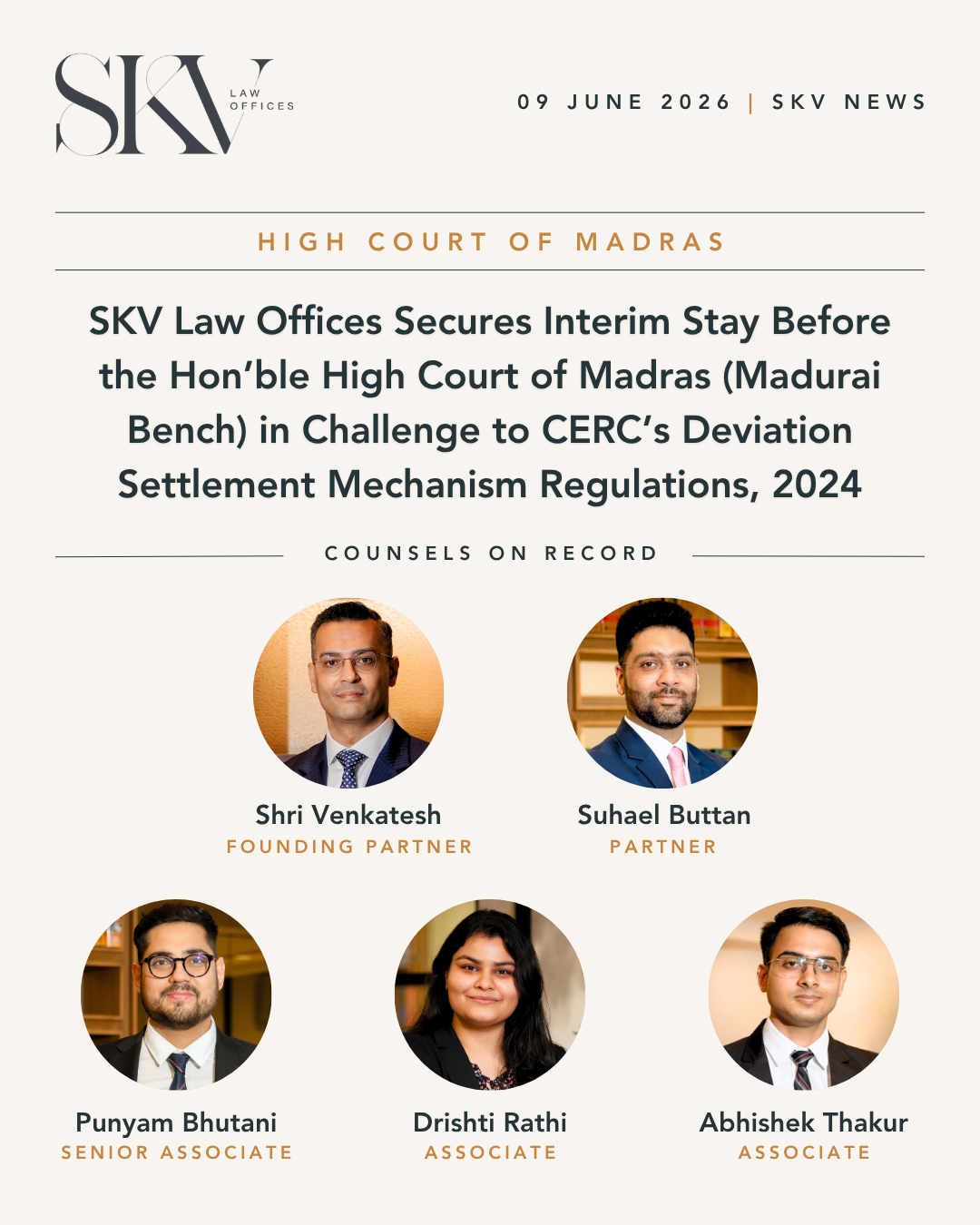
SKV Law Offices Secures Interim Stay Before the Hon’ble High Court of Madras (Madurai Bench) in Challenge to CERC’s Deviation Settlement Mechanism Regulations, 2024
09.06.2026
SKV Law Offices successfully represented NTPC Green Energy Limited (“NGEL”), NTPC Renewable Energy Limited (“NREL”) and NTPC Limited (“NTPC”), collectively referred to as the (“Petitioners”) before the Hon’ble High Court of Madras (Madurai Bench) (“Hon’ble High Court”), securing an interim stay of the operation and implementation of Regulations 6(2)(b) and 8(4) of the Central Electricity Regulatory Commission (Deviation Settlement Mechanism and Related Matters) Regulations, 2024 (“Impugned Regulations”) until the next date of hearing. In the meanwhile, the provisions of the DSM Regulations, 2014 shall continue to govern the Petitioners.
Background
NGEL, NREL and NTPC are generating companies within the meaning of Section 2(28) of the Electricity Act, 2003 (“Electricity Act”) and are involved in establishing and operating several solar and wind power projects across India, including in the State of Tamil Nadu. Notably, NGEL owns and operates (originally developed by NTPC) a 230 MW Solar PV Power Station at Navalakkapatti, Ettayapuram Taluk, Tuticorin, Tamil Nadu (“Project”) under a Power Usage Agreement dated 26.11.2020, with a fixed tariff of Rs. 2.69/kWh for a period of twenty-five years.
The Central Electricity Regulatory Commission (“CERC“) notified the Impugned Regulations on 05.08.2024, effective 16.09.2024. With effect from 01.04.2026, the Impugned Regulations altered the deviation settlement framework for Wind-Solar (“WS Sellers“) in two respects: Regulation 6(2)(b) replaced the long-standing “Available Capacity” denominator in the deviation formula with a composite denominator incorporating a variable “X” whose value was left unspecified at notification and determined only belatedly through Order dated 31.03.2026 in Petition No. 9/SM/2025; and Regulation 8(4) tightened the permissible deviation bands and eliminated all compensation for over-injection beyond the revised thresholds. The combined effect substantially enhanced deviation-related financial exposure for WS Sellers compared to the then-prevailing DSM Regulations, 2014.
The Challenge
The Petitioners filed the instant Writ Petition challenging the constitutional validity and vires of Regulations 6(2)(b) and 8(4) of the Impugned Regulations on the following grounds: (a) violation of the mandatory prior publication requirement under Section 178(3) of the Electricity Act inasmuch as the revised deviation formula introduced by Regulation 6(2)(b) was absent from the Draft Regulations circulated for public consultation and was introduced for the first time in the final notified Regulations, thereby denying stakeholders any opportunity to comment or object; (b) manifest arbitrariness under Article 14 of the Constitution of India (“Constitution”), given the absence of any independent technical study, empirical evidence or cogent rationale for the tightened framework, and the fact that statutory expert bodies including the Central Electricity Authority (“CEA”) and the Ministry of New and Renewable Energy (“MNRE”) had specifically advised against further tightening; (c) violation of the principle of regulatory certainty and legitimate expectation, the deviation framework having been revised repeatedly within a short span of time to the detriment of projects bid, financed and implemented on the basis of the pre-existing regime; (d) violation of the Must Run status accorded to renewable generators, by creating financial disincentives that effectively amount to economic curtailment; (e) violation of Articles 300A and 19(1)(g) of the Constitution, (f) impermissible retrospective impact on existing projects in respect of which tariffs have been discovered and Power Purchase Agreements executed; and (g) contravention of the statutory objective of promoting renewable energy under the Electricity Act.
Submissions by SKV Law Offices
SKV Law Offices advanced submissions before the Hon’ble High Court establishing a strong prima facie case on the procedural and substantive illegality of the Impugned Regulations. It was submitted that Regulation 6(2)(b) suffers from a patent procedural illegality, the revised deviation formula having been absent from the Draft Regulations, 2024 circulated for public consultation and introduced for the first time in the final Regulations, contrary to the mandatory requirements of Section 178(3) of the Electricity Act read with the Electricity (Procedure for Previous Publication) Rules, 2005.
It was further submitted that the Impugned Regulations are hit by the doctrine of manifest arbitrariness, being unsupported by any independent technical study or empirical data, and that the CEA and MNRE had specifically cautioned against further tightening, acknowledging continued inadequacy of forecasting accuracy for renewable generation. It was also highlighted that the variable “X” was left unspecified for over eighteen months, with its value determined only on 31.03.2026, a single day before the revised formula was due to take effect. The Petitioners further relied on the stay granted by the Hon’ble High Court of Karnataka in W.P. No. 13260 of 2026 vide Order dated 27.04.2026, and contended that generators not covered by that order, not being members of the National Solar Energy Federation of India, faced the immediate risk of removal from Qualified Coordinating Agency (“QCA”) aggregation absent a similar protective order, causing irreparable prejudice.
Interim Stay Granted
Having regard to the submissions made, the Hon’ble High Court of Madras (Madurai Bench) admitted the Writ Petition, issued notice to the Respondents, and granted an interim stay of the operation and implementation of Regulations 6(2)(b) and 8(4) of the Impugned Regulations until the next date of hearing. The Hon’ble Court further directed that in the meanwhile, the provisions of the DSM Regulations, 2014 shall continue to govern the Petitioners.
Significance of the Relief
The interim stay is of significant importance for renewable energy generators operating under long-term, fixed-tariff Power Purchase Agreements in the State of Tamil Nadu and across the Southern Region. The order protects the Petitioners from the immediate application of the revised deviation computation methodology and the tightened settlement framework, both of which would have imposed substantial and irreversible financial liabilities on projects whose tariffs cannot be revised to absorb such changes. In the absence of this relief, and given the Petitioners’ status as generators not covered by the Karnataka High Court order, the Petitioners faced the additional operational risk of being excluded from QCA aggregation, thereby losing the benefit of pooled scheduling and further magnifying their deviation exposure.
The order also carries wider significance for the renewable energy sector. It reinforces the principle that subordinate legislation imposing substantial financial consequences upon regulated entities must comply with the mandatory prior publication and stakeholder consultation requirements of the Electricity Act and must be founded on cogent empirical material rather than speculative assumptions about future improvements in forecasting capability. The stay further affirms that the long-standing framework under the DSM Regulations, 2014, which recognised the inherent variability of renewable generation and provided a stable, commercially workable basis for project financing and implementation, remains the appropriate reference point for renewable energy generators until the legality of the revised framework is finally adjudicated.
Team
The matter was argued by Mr. V. Raghavachari, Senior Advocate assisted by Mr. Shri Venkatesh (Founding Partner), Mr. Suhael Buttan (Partner), Mr. Punyam Bhutani (Senior Associate), Ms. Drishti Rathi (Associate) and Mr. Abhishek Thakur (Associate) of SKV Law Offices.