

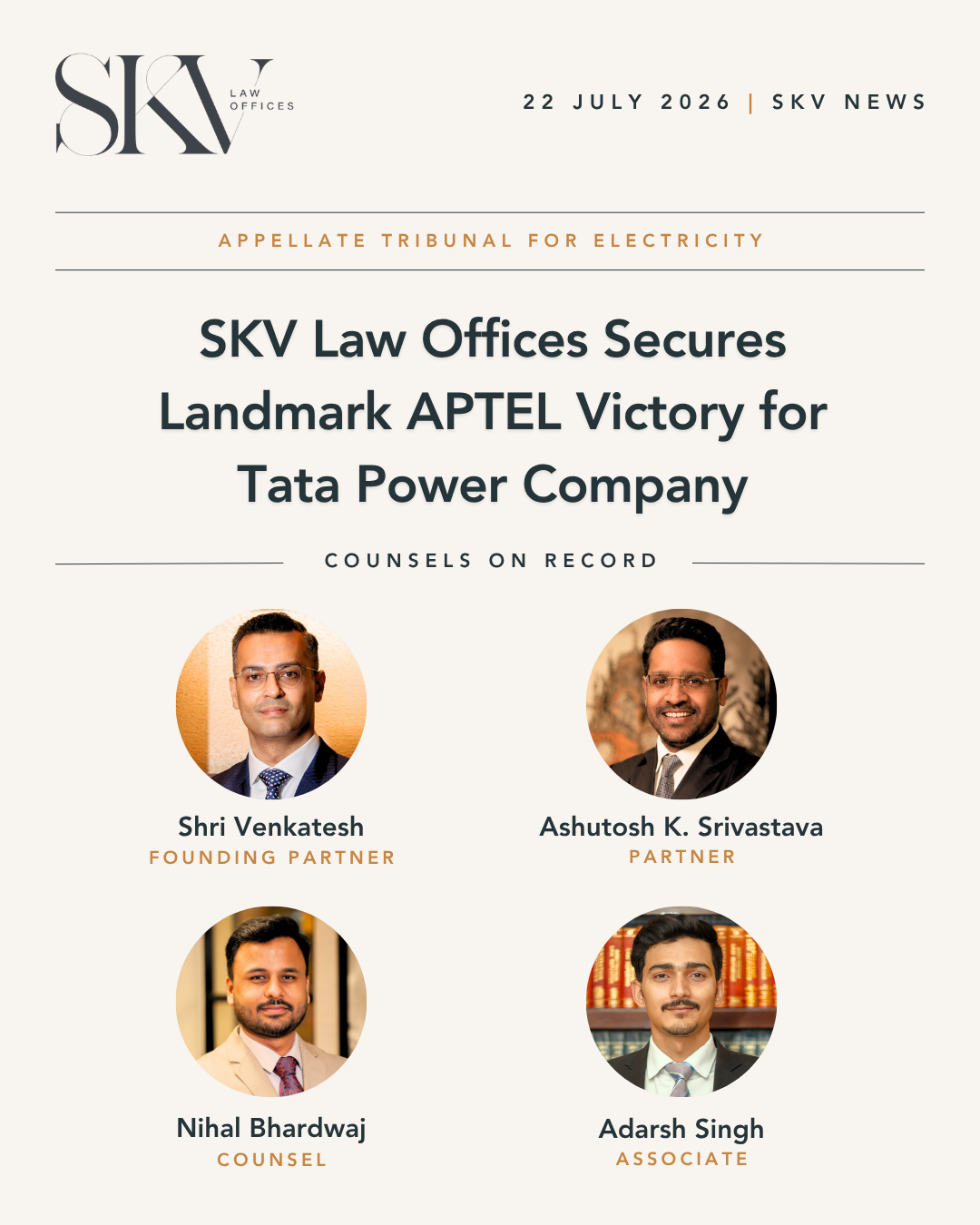
SKV Law Offices Secures Landmark APTEL Victory for Tata Power Company Tribunal Affirms Primacy of Delegated Legislation: Normative Regulatory Parameters Cannot Be Diluted by Tariff Orders
04.08.2026
SKV Law Offices successfully represented The Tata Power Company Limited (“TPCL”) before the Appellate Tribunal for Electricity (“APTEL”) in Appeal No. 419 of 2022, securing a landmark judgment dated 22.07.2026 that reaffirms the binding character of delegated legislation and the limited scope of regulatory “relaxation” powers. In this precedent-setting decision, APTEL allowed TPCL’s appeal on substantially all eight contested issues, setting aside key disallowances by the Jharkhand State Electricity Regulatory Commission (“JSERC”) and establishing critical principles governing the relationship between regulatory norms and tariff determination.
The Matter
TPCL challenged the JSERC order dated 27.12.2019 in Case No. 05 of 2018 pertaining to the truing-up of tariff for FY 2016-17 and Annual Performance Review for FY 2017-18 for Units 2 and 3 (120 MW each) of the Jojobera Thermal Power Plant in Jamshedpur, from which power is supplied to Tata Steel Limited. The disputed order disallowed or partially allowed Rs. 19+ crore across eight distinct heads, including raw water charges, secondary fuel oil costs, additional capitalisation, depreciation, and carrying cost.
Principal Legal Issues
The appeal raised critical questions on the legal hierarchy between delegated legislation and quasi-judicial tariff orders; the permissible scope of a regulator’s “power to relax” and “power to remove difficulties”; the standards for prudence review in true-up exercises; the treatment of decapitalisation and loan components; and the statutory character of carrying cost entitlements.
SKV’s Submissions
SKV advanced that Regulation 8.4 of the JSERC (Terms and Conditions for Determination of Generation Tariff) Regulations, 2015 (“GTR 2015”) prescribes an unambiguous normative Secondary Fuel Oil Consumption of 1 ml/kWh for the subject units. The power to “relax” is remedial and exceptional; it cannot be invoked to unilaterally tighten a norm to the prejudice of a regulated entity without procedural safeguards or notice. Further, decapitalisation of original project assets—on which the original loan has been fully repaid—cannot be netted against new Additional Capitalisation to artificially reduce the loan component attributable to current capex. Raw water charges, being allowable on an actual basis under Regulation 7.46, do not generate savings against normative benchmarks and should not be included in tax liability calculations on O&M savings. Finally, carrying cost under Regulation 6.18 is a statutory entitlement, not discretionary; denial based on delayed true-up filing overlooks the principle of lex non cogit ad impossibilia when filing is rendered impossible by prior regulatory events.
APTEL’s Landmark Holdings
The Tribunal affirmed that Regulations framed under Section 181 of the Electricity Act, 2003 are binding delegated legislation and cannot be transgressed by tariff orders. A quasi-judicial tariff determination is merely an application of the Regulations; it cannot amend, rewrite, or dilute normative standards prescribed therein. Applying the maxim generalia specialibus non derogant, APTEL held that Regulation 8.4, as a special provision for existing stations, prevails over the general controllable-parameter regime in Regulation 6.11. The “power to relax,” while available, is confined to exceptional dispensation; it cannot be wielded suo motu to harden norms against obligated parties or bypass statutory amendment procedures. On decapitalisation, the Tribunal accepted that applying debt-equity ratios to netted figures artificially compresses loan allowances, and directed that historic values be computed on actual-approved costs and handled separately from original assets.
Consequential Directions
APTEL set aside the disallowance of secondary fuel oil costs and remanded for recalculation strictly per Regulation 8.4 norms. The Rs. 1.24 crore disallowance in additional capitalisation was also set aside, with a remand for proper prudence review. Issues pertaining to raw water charges, decapitalisation methodology, depreciation on original cost, and tax liability were remanded with detailed directions. Critically, APTEL held TPCL entitled to carrying cost on the approved revenue gap and directed the JSERC to pass consequential orders, inclusive of carrying cost, within three months.
Sectoral Significance
This judgment is precedent-setting for the power sector. It establishes that delegated legislation is supreme within its domain and cannot be effectively rewritten through tariff orders. It confines regulatory “relaxation” powers to their remedial purpose, relief in hardship cases, and forecloses their use as a backdoor to amend Regulations. It affirms that generators achieving better-than-norm performance retain efficiency gains and cannot be penalised by forced norm reductions. It protects regulated entities from carrying-cost denial occasioned by delays beyond their control, reinforcing the statutory character of time-value compensation. For large thermal generators like TPCL operating under multi-year tariff and true-up frameworks, the judgment provides critical certainty that normative standards will be applied consistently and that tariff-order reasoning must remain tethered to the regulatory text.
Legal Team
The matter was led by Mr. Shri Venkatesh (Founding Partner), assisted by Mr. Ashutosh K. Srivastava (Partner), Mr. Nihal Bhardwaj (Counsel), and Mr. Adarsh Singh (Associate) from SKV Law Offices.