

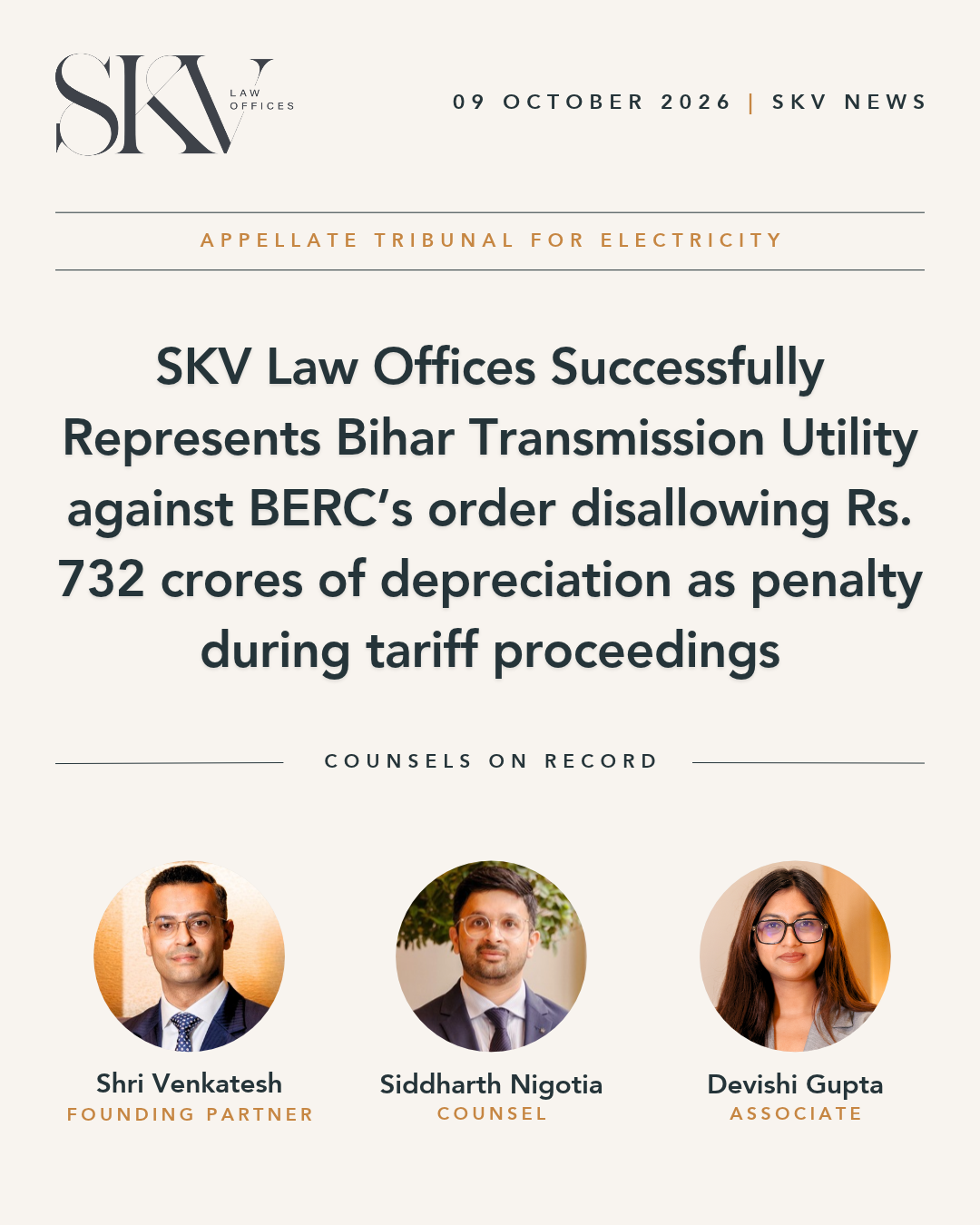
SKV Law Offices successfully represented Bihar State Power Transmission Company Limited (“BSPTCL”) before the Appellate Tribunal for Electricity (“APTEL”) in Appeal No. 329 of 2025. By its Judgment dated 09.10.2026, APTEL set aside the decision of the Bihar Electricity Regulatory Commission (“BERC”) to disallow 25% of BSPTCL’s depreciation because BSPTCL had not submitted a Fixed Asset Register (“FAR”).
In the true-up for FY 2023-24 alone, BERC had disallowed Rs. 118.98 crore. It applied the same 25% deduction to the tariff control period FY 2025-26 to FY 2027-28. Across these tariff years, BERC effectively disallowed over ~Rs. 732 crore of depreciation. APTEL held that BERC could not deduct depreciation, which is a legitimate cost, merely because the FAR had not been submitted, since doing so was outside the statutory framework. Given the quantum of disallowance involved, the judgment provided significant relief to the State Utility.
Background
On behalf of BSPTCL, Shri Venkatesh argued that under the prevalent law, the State Commissions do not have power to levy penalty during tariff proceedings for any alleged non-compliance of directions passed by BERC, or alleged non-compliance of regulations. Penalty, if any, could only be levied by following the mechanism provided in Section 142 of the Electricity Act, 2003. It was also submitted that Tariff Regulations framed by BERC did not provide for any deduction in depreciation if the FAR is not submitted, and that the deduction was in substance a penalty imposed through tariff proceedings.
BERC had argued that the levy was justified in view of alleged continued non-compliance by BSPTCL regarding non-submission of FAR. Further, BERC had relied on its inherent powers under the tariff regulations to contend that it was permitted in law to effect such deductions. However, these arguments were rejected and BSPTCL was granted relief.
APTEL’s Decision
APTEL accepted BSPTCL’s primary argument that Utilities cannot be penalized during tariff proceedings for non-compliance of directions or regulations. APTEL also held that the Regulations require the FAR to be submitted but do not prescribe a deduction in depreciation as the consequence of not doing so. Therefore, the findings of BERC were erroneous.
Relying on the Supreme Court’s decision in GUVNL v. Solar Semiconductor Power Company (2017) 16 SCC 498, the Tribunal held that a Commission, being a creature of statute, cannot assume powers not conferred on it. Where the Act provides a specific route for non-compliance through Section 142, the Commission cannot convert its tariff-fixation power into a penalty proceeding. APTEL also held that Tariff Regulations do not authorise arbitrary changes/deductions to substantive tariff elements. In doing so, it followed its earlier decisions in MSEDCL v. MERC, JBVNL v. JSERC and Appeal No. 98 of 2021.
In light of the same, the impugned order was set aside to the extent of the 25% disallowance of depreciation.
Significance of the Decision
The judgment firmly settles the law that State Commissions cannot use tariff proceedings to levy penalties on Utilities for non-compliance of directions or regulations as the Electricity Act, 2003 provides a separate mechanism for such non-compliance. In other words, the judgment confirms that regulators cannot impose ad hoc tariff disallowances as a substitute for the statutory penalty mechanism. Moreover, any disallowance must be grounded in the governing tariff norms.
Our Team
SKV Law Offices represented BSPTCL through Shri Venkatesh, Founding Partner, Siddharth Nigotia, Counsel and Devishi Gupta, Associate.